
A late mortgage payment: what happens now and how to recover

A late mortgage payment usually triggers a fee first, not a credit report entry. Most lenders build in a grace period of around two weeks before anything shows up as officially late, and if you bring the account current within that window, or even within about 30 days, it typically never reaches the credit bureaus at all. The single best move: call your lender or servicer today, explain what happened, and arrange payment or a short-term plan before the 30-day mark passes.
- Grace period: commonly around two weeks after the due date
- Reporting threshold: most servicers report to bureaus around 30 days late
- Likely cost: a late fee, usually a flat charge or a percentage of the payment
Quick fact: payments reinstated inside that first month often leave no trace on your credit file, which is why speed matters more than almost anything else here.
Key Takeaways
Recent housing payment history carries more weight with lenders than almost any other credit factor, and speed of resolution determines nearly everything that follows.
| Point | Details |
|---|---|
| Act inside 30 days | Reinstating a payment before the 30-day mark often prevents a credit bureau report entirely. |
| Late fees come first | Most lenders charge a fee after the commonly around two-week grace period, before anything reaches your credit file. |
| Records last up to 7 years | A reported late payment can stay on your credit report for up to seven years, even once resolved. |
| Recency shapes your options | Mainstream lenders typically want 12 to 24 months of clean payments before offering standard rates. |
| Specialist lending fills the gap | Mortgages Fast connects borrowers with recent late payments to private and specialist lenders across 60+ options while mainstream eligibility rebuilds. |
Authoritative government and consumer resources to consult next
- FCAC guidance on paying your mortgage during financial difficulty
- FCAC mortgage deferral tools and amortization guidance
- FCAC mortgage calculators for estimating payment changes
This article is general information, not a substitute for advice from a qualified financial advisor. Consult a qualified financial professional about your own circumstances before acting on anything here.
Table of Contents
- What’s the difference between a “late” mortgage payment and a “missed” one?
- What’s the realistic timeline from late payment to enforcement?
- How does a late payment change your credit profile and mortgage options?
- What should you do in the first 48 hours after a payment slips?
- Can you still get a mortgage with late payments on file?
- How Mortgages Fast helps borrowers with recent late payments
- Does a late payment affect your mortgage insurance or escrow account?
- Could a late payment cost you at tax time?
- Do government-backed programs treat late payments differently?
- Talk to Mortgages Fast before your next payment date
- Sources
What’s the difference between a “late” mortgage payment and a “missed” one?
“Late” and “missed” get used interchangeably, but lenders treat them very differently. A late payment is one made after the due date but inside the grace period, usually resolved with a fee and no lasting mark. A missed payment crosses into delinquency territory: it’s still unpaid once the grace period closes, and that’s when the servicer starts building a formal file on your account.
- 30 days late: reported to credit bureaus, appears on your report
- 60 days late: considered a more serious delinquency, often triggers direct servicer contact
- 90 days late: frequently the point where formal default proceedings begin
A single isolated incident (a payment date you genuinely forgot) reads very differently to an underwriter than three late payments spread across six months. Patterns suggest instability. One slip suggests bad luck.
What’s the realistic timeline from late payment to enforcement?
Once a payment slips past the grace period, a fairly predictable sequence kicks in. Understanding it helps you know exactly how much runway you actually have.
- First couple of weeks: Grace period. No fee yet in most cases, no report.
- Typically after the grace period: Late fee applied, often calculated as a flat amount or a small percentage of the missed payment.
- Day 30: Delinquency typically reported to credit bureaus if the account is still unpaid.
- Day 60 to 90: Servicer contact intensifies, and formal delinquency notices may be sent.
- Beyond 90 days: Lenders may issue a demand letter or notice of default, opening the door to power of sale or foreclosure proceedings, timing varies by province and lender.
One number worth remembering: a late payment reported at the 30-day mark can stay on your credit report for up to seven years, even after the account is fully current again. That’s the real cost of letting day 30 pass without a plan.
How does a late payment change your credit profile and mortgage options?
A 30-day late payment on a mortgage tends to hit your score harder than almost any other late debt. Lenders and scoring models both treat housing payment history as the clearest signal of how you handle financial pressure, so an isolated late credit card bill barely compares to a recent mortgage arrear. A 60-day late does more damage, and a 90-day late can push your file into a different risk category entirely, sometimes for years.
That doesn’t shut every door. It just changes which ones open easily.
- Mainstream banks: Want a clean recent payment history, usually 12 to 24 months of on-time payments before they’ll offer their best rates.
- Challenger and monoline lenders: More flexible on an isolated incident, especially with a strong explanation and stable income.
- Specialist or private lenders: Will consider recent late payments through manual underwriting, but expect higher rates and larger deposit requirements in exchange for that flexibility.
Pro Tip: Pull your credit report before applying anywhere. If the late payment was reported in error, or the date is wrong, disputing it now can sometimes correct your file within days, before a lender ever sees it.
What should you do in the first 48 hours after a payment slips?
Speed changes outcomes here more than almost any other factor. Here’s the order that actually protects your options.
- Reinstate the payment immediately if you have the funds. Getting current inside 30 days is usually the difference between a fee and a credit mark.
- Call your lender or servicer directly. Have your account number, a brief explanation of what happened, and your next pay date ready.
- Ask specifically about relief options. Repayment plans, deferrals, extended amortization, or even selling the property are all standard responses lenders are expected to offer when a borrower is struggling.
- Understand the trade-off of a deferral. FCAC’s mortgage deferral tools show how skipping payments now often adds meaningfully to your total interest cost later.
- Stick to your lender and legitimate government channels. Third parties promising to “erase” a late payment for a fee are a scam. No one can remove an accurate record from your credit file.
Pro Tip: Write down every phone call: date, time, name of the representative, and what was agreed. If a dispute arises later, that log is your best evidence.
Can you still get a mortgage with late payments on file?
Yes, and recency is the variable that matters most. A single 30-day late payment from two years ago barely registers with most mainstream lenders today. The same late payment from two months ago is a different conversation entirely.
- 6 months out: Mainstream approval is unlikely unless compensating factors (large down payment, strong income) are exceptional.
- 12 months out: More lenders start looking past an isolated incident, particularly with a clean record since.
- 24 months out: Most standard lending tiers reopen, assuming no repeat incidents.
You can improve your odds well before those clocks run out. Disputing genuine credit report errors, paying down credit card balances to lower utilisation, and stacking up consistent on-time payments all help rebuild trust with underwriters faster than time alone. Reviewing where you stand with a tool like these credit repair strategies before you apply can save you a wasted application.
When timing doesn’t allow for waiting, a specialist or private mortgage is often the practical answer. These lenders rely on manual underwriting rather than automated scoring cutoffs, which means a recent late payment doesn’t automatically disqualify you, though you’ll typically pay a higher rate and put down more upfront. A broker with access across dozens of lenders can identify which ones are realistically open to your file and avoid the wasted applications that drag your score down further.
How Mortgages Fast helps borrowers with recent late payments
This is exactly the situation Mortgages Fast is built for. We work with over 60 lenders across Toronto and the GTA, including private and specialist options that mainstream banks won’t touch when a file shows recent arrears. Instead of one bank saying no, you get a broker running your file against dozens of lenders who each weigh risk differently.
We’re typically the right call when you’re under time pressure (a closing date approaching, a renewal coming up), when the late payment happened in the past few months and mainstream approval isn’t realistic yet, or when you need financing now with a plan to refinance into a better rate once your history clears.
Before you contact us, gather:
- Your last 12 months of mortgage payment history
- A brief written explanation of what caused the late payment
- Proof the arrears are resolved (payment confirmation, current statement)
- Recent income documentation (pay stubs, T4s, or business financials if self-employed)
- A list of assets or down payment sources available
| What you bring | Why it matters |
|---|---|
| Payment history | Shows lenders whether this was isolated or a pattern |
| Explanation letter | Gives underwriters context a credit report alone can’t |
| Proof of resolution | Confirms the account is current, not still delinquent |
| Income and asset documents | Determines which lender tier and rate you’ll qualify for |
Does a late payment affect your mortgage insurance or escrow account?
If your mortgage includes an escrow-style account for property tax and insurance (common when your down payment is under 20%), a late payment can ripple into that account too. Miss a payment, and the portion meant to cover your annual property tax and insurance premium doesn’t get collected on schedule either. That can create a shortfall the servicer has to correct later, usually by raising your monthly payment slightly the following year to catch the account back up.

Mortgage default insurance itself, the premium charged when your down payment is below 20%, isn’t cancelled or refunded because of a late payment. It stays in force based on the original loan terms. But a late payment does factor into how a lender evaluates your risk profile going forward, particularly if you’re looking to remove that insurance requirement later through refinancing at a higher equity position.
Where this gets genuinely costly is compounding. A late mortgage payment plus a shorted escrow account plus an eventual makeup payment can stack up fast, especially if it happens more than once. Ask your servicer directly whether your escrow account is in a shortfall position after any late payment. Most will tell you plainly, and some will let you spread the makeup amount over several months rather than demanding it all at once. That conversation costs you nothing and can prevent a second financial surprise landing on top of the first.
Could a late payment cost you at tax time?
For most homeowners, a late mortgage payment doesn’t directly change your tax situation the way it might with a business loan or investment property. Principal residence mortgage interest generally isn’t tax-deductible in the first place, so there’s no deduction to lose by paying late.
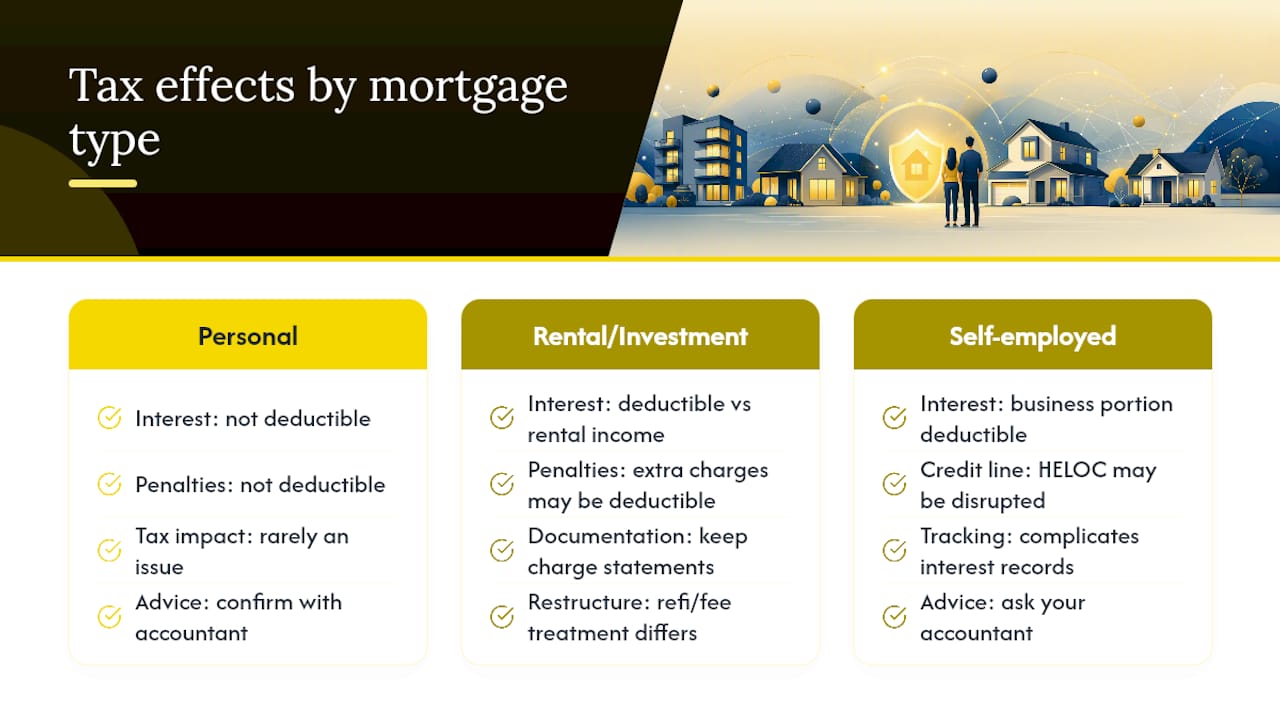
Where it can matter is if you own a rental or investment property carrying a mortgage. Interest on that debt is typically deductible against rental income, and if a late payment triggers extra interest charges or penalty fees, those additional costs may actually be deductible too, provided they’re tied to earning rental income. Keep every statement showing exactly what was charged and why. If your late payment led to a lender restructuring your loan, refinancing fees or penalty interest may need to be treated differently for tax purposes than your regular ongoing interest.
If you’re self-employed and used a home equity line tied to your mortgage for business purposes, a late payment that disrupts that credit line could complicate how you’re tracking deductible interest for the business portion. This is a narrow scenario, but a common one among the self-employed clients we see.
None of this replaces proper tax advice. A late payment on a personal residence mortgage rarely creates a tax problem on its own, but if you’re carrying an investment property or business-use credit tied to the same mortgage, talk to an accountant before assuming nothing changed.
Do government-backed programs treat late payments differently?
FHA, VA, and USDA-backed loans are US programs and don’t apply to Canadian mortgages. If you’re reading from the United States and carrying one of these loans, the general principle still holds: government-backed programs typically build in specific loss mitigation options, forbearance plans, and loan modification pathways that are often more structured than what a conventional lender offers, precisely because these programs exist to keep people housed.
In Canada, the closest equivalent isn’t a single program but a framework. The Financial Consumer Agency of Canada expects federally regulated financial institutions to offer relief options when a borrower is struggling, including repayment plans, payment deferrals, extending your amortization, or in more serious cases, selling the property before things escalate to enforcement. There’s no single government-backed insurance program that intervenes directly the way FHA does in the US, but CMHC-insured mortgages (the ones with less than 20% down) still fall under the same lender obligations to explore alternatives before foreclosure.
The practical takeaway for a Canadian borrower: your lender is expected to work with you, but that expectation only helps if you initiate contact early. Waiting for the bank to reach out rarely goes well.
A short first-person broker perspective on realistic expectations
An isolated late payment and a pattern of them are not the same problem, and lenders know it instantly. Most borrowers can realistically rebuild mainstream eligibility within 12 to 24 months of clean payments. What actually restores lender trust isn’t a grand gesture. It’s boring consistency: on-time payments, month after month, with no drama.
— Mortgages
Talk to Mortgages Fast before your next payment date
If a recent late payment has you worried about your next renewal or a purchase closing, Mortgages Fast gets you in front of lenders your bank branch simply doesn’t have access to. Where a single bank sees one late payment and stops reading your file, we run it against a network of over 60 lenders, including private and specialist options built specifically for borrowers whose credit history isn’t perfectly clean right now.

Before you call, pull together your last year of mortgage statements, a short written explanation of what happened, and your current income documents. If your situation calls for something outside conventional lending, our private mortgage solutions are designed exactly for files that need manual underwriting rather than an automated decline. Reach out to Mortgages Fast today and let’s find out which of our 60+ lenders is actually willing to say yes.
Sources
- Paying your mortgage when experiencing financial difficulties — Government of Canada (FCAC)
- Mortgage deferrals — Government of Canada (FCAC)
- Can I get a mortgage with late payments? — Experian
- Here’s what happens if you miss a mortgage payment — NerdWallet Canada